


Advanced Ultrasonic Technology in the Food Industry
Advanced Ultrasonic Technology in the Food Industry

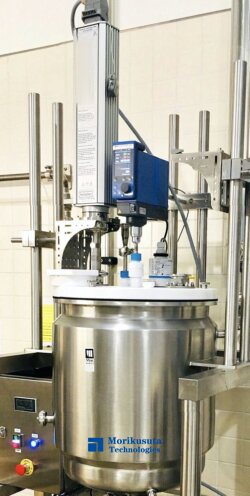
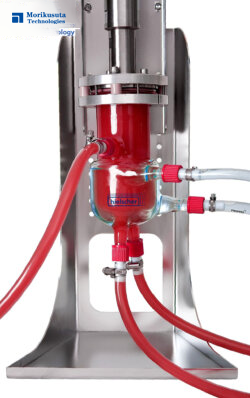
Ultrasonic Technology in the Food Industry
The application of power ultrasound in food processing is extensive, encompassing extraction, homogenization, pasteurization, fermentation, and more. As a non-thermal processing method, ultrasonic treatment optimizes food production processes by increasing yield, improving quality, enhancing nutritional and flavor characteristics, and saving time and cost.
Applications of Ultrasound in Food Processing
High-power ultrasound has a wide range of applications in food processing, including extraction, mixing, emulsification, pasteurization, degassing, and meat tenderization. Beyond these primary uses, high-power ultrasound is also employed to improve food freezing, thawing, and drying processes.
The main advantage of high-intensity ultrasound lies in its ability to enhance various food processing operations, such as reducing processing time, increasing yield, improving product quality, and enabling more economical and time-efficient processing.
In the following paragraphs, you can find the main applications of high-intensity ultrasound in the food industry:
Extraction: Ultrasound can be used to extract bioactive compounds like antioxidants, pigments, and essential oils from plant materials. This process, known as ultrasonically-assisted extraction, produces high-quality extracts in less time and with lower solvent consumption compared to traditional methods.
Homogenization and Emulsification: Ultrasonic homogenization can be used to prepare stable emulsions and suspensions, such as salad dressings, mayonnaise, creams, and dairy products. The process uses high-frequency sound waves to break down fat globules in liquids, resulting in a product with a uniform and fine texture.
Preservation and Storage: High-intensity ultrasound can be used to inactivate microorganisms (e.g., bacteria, yeast) in food. This process, known as ultrasonically-assisted pasteurization, can extend the shelf life of food and reduce the risk of food poisoning. As a non-thermal processing technology, it avoids the use of extremely high temperatures, thereby preventing the degradation of heat-sensitive nutrients.
Degassing: When ultrasound is applied to a liquid, entrained gas bubbles are agitated. This causes the air and gas bubbles to move closer together and coalesce. This means they grow to a larger bubble size, allowing them to rise to the liquid's surface and be easily removed.
Dissolution Processes: Due to its excellent mixing and fusion capabilities, ultrasound is highly effective in preparing high-concentration or even supersaturated solutions. This technique is commonly used in crystallization processes and in the production of brines.
Fermentation Processes: When ultrasound penetrates and disrupts the cell walls of microorganisms, they become more susceptible to fermentation processes. Simultaneously, ultrasound accelerates the transport of nutrients and oxygen to the microorganisms, enhancing their metabolic activity. Overall, sonication increases the fermentation rate, shortens fermentation time, and improves the yield of the desired end product. This technique is particularly suitable for producing food and beverage products like dairy products, yogurt, beer, kombucha, and wine.
Viscosity Reduction before Spray Drying: Ultrasonic shear forces can significantly reduce the viscosity of shear-thinning and thixotropic slurries. Applying ultrasonic shear thinning before spray and atomization drying equipment can substantially increase the throughput of the spraying apparatus. Spray drying towers are often bottlenecks in production lines. With ultrasonic technology, the capacity of existing spray dryers can be increased.
Freezing: Ultrasonic freezing can be used to reduce ice crystal formation during food freezing. The process involves exposing the food to high-frequency sound waves while it is being frozen. The ultrasound creates vibrations that prevent the formation of large ice crystals, resulting in a product with a smoother texture and better quality.
Thawing: Ultrasonic thawing can be used to reduce the thawing time of frozen foods. The process involves subjecting the frozen food to ultrasound, which generates heat and accelerates the thawing process. Ultrasonic thawing is particularly useful for foods that are difficult to thaw evenly, such as meat, seafood, fruits, and vegetables, as it promotes uniform energy distribution. In freezing, thawing, and drying processes, high-intensity ultrasound significantly improves quality and energy transfer, speeding up these processes and making them more economical.
Bottle Leak Detection: Ultrasound is a very effective method for detecting leaks and cracks in bottles and cans of carbonated beverages, such as soda, beer, and sparkling wine. Ultrasonic technology is also used for degassing carbonated drinks, for example, debubbling beer before bottling.
Brine Salting / Marinating/Pickling: Brining is a common treatment in food preservation and processing, especially for meat, fish, cheese, and vegetables. Ultrasonic treatment can shorten brining time and allows for the use of less sodium chloride compared to traditional brined foods and pickles.
Watering / Rehydration: Power ultrasound is a simple yet highly effective method for adding water or rehydrating foods, such as dried legumes (e.g., beans, chickpeas) or dehydrated mushrooms. As ultrasound opens the cell pores in the food, water can penetrate quickly. This causes the legumes to swell rapidly, reducing cooking time.
Honey Decrystallization: As a non-thermal processing method, ultrasound is effectively used to prevent the formation of large sugar crystals in honey. Furthermore, large crystals already present in honey can also be removed by ultrasonic treatment. As an efficient dissolution technique, probe-type ultrasonicators can dissolve sugar crystals, making the honey homogeneously fine. Additionally, ultrasound can improve the microbial quality of honey, as harmful microorganisms are inactivated due to the cell-destroying effect of ultrasound.
Frying: Ultrasonic frying can be used to reduce oil uptake in fried foods. This process involves immersing the food (meat or vegetables) in hot oil while subjecting it to high-frequency sound waves. The ultrasound creates small bubbles on the food's surface, reducing the contact area between the vegetable/meat and the oil, resulting in less oil absorption and a healthier final product. Ultrasonic frying can cook food at lower temperatures, creating premium flavor and preserving nutrients.
High-Performance Ultrasonic Processors for Food Processing
The industrial ultrasonic processors supplied by Hielscher Ultrasonics are high-performance ultrasonic devices. Their precise controllability ensures highly reproducible production results and consistent product quality. The equipment can deliver very high amplitudes, sufficient for various demanding applications.
Customers appreciate the exceptional robustness and reliability of Hielscher's ultrasonic systems. These ultrasonic devices reliably handle heavy-duty applications, harsh environments, and continuous 24/7 operation, ensuring efficient and economical food processing. Ultrasonic process intensification technology can shorten processing times and achieve better outcomes – including improved quality, higher yield, and the development of innovative products. The consistent use of special materials like titanium, stainless steel, ceramics, or various grades of glass ensures full compatibility with the technology and processes.
Ultrasonic processors are easy to operate and use, require low maintenance, and are relatively low in price.
Design, Manufacturing & Consulting – German Quality Excellence
Hielscher ultrasonic devices are known for their top quality and design standards. Excellent robustness and ease of operation allow our devices to be seamlessly integrated into industrial production lines, even under harsh operating conditions and demanding environments.
As an ISO-certified company, Hielscher's ultrasonic technology partner company consistently focuses on developing high-performance ultrasonic devices that combine cutting-edge technology with user-friendly design. All products are CE compliant and meet international standards such as UL, CSA, and RoHs.
Important Facts Worth Knowing
How Ultrasonic Food Processing Works
Ultrasonic food processing is an established technology widely used in food processing for mixing homogenization, emulsification extraction, dissolution degassing, meat tenderization, crystallization, and the functionalization of intermediates and final products. As equipment that has been operating reliably in food production plants for decades, Hielscher ultrasonic food processors continue to meet industry needs through precise design. The device utilizes the physical forces generated by power ultrasound to induce cavitation, enabling efficient processing.
Explanation of Acoustic Cavitation
Acoustic cavitation (also known as ultrasonic cavitation) refers to the formation and implosive collapse of micro-vacuum bubbles in a liquid or slurry under the influence of an ultrasonic field. These cavitation bubbles grow over several high-pressure/low-pressure cycles (compression and rarefaction phases). After several pressure-alternating cycles, the vacuum bubbles reach an energy saturation threshold and implode violently during a high-pressure cycle. When the bubbles collapse, they create localized extreme conditions: instantaneous temperatures up to 5000 K with rapid heating/cooling rates, pressure peaks up to 2000 atmospheres and corresponding pressure differentials, and liquid jet speeds up to 280 m/s. Within these cavitation "hot spots," the specific physical conditions created by these extreme forces enable efficient mixing, extraction, and mass transfer intensification.
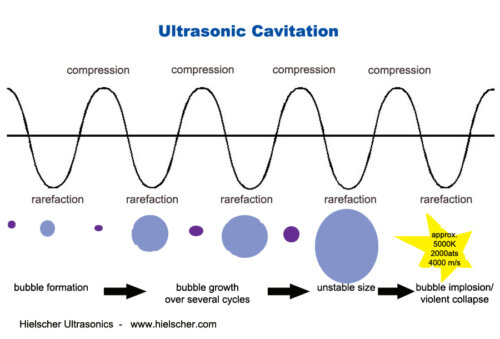
The acoustic cavitation effects (generated by high-intensity, low-frequency ultrasound) create intense shear forces and localized high pressures and temperature differences, providing the necessary forces for enhanced mixing and mass transfer. This ultrasonic shear technology is now successfully applied in the field of food processing.

Morikusuta Technologies Inc.
| 
|
 ADD:6547 N Academy Blvd #2266 Colorado Springs Co 80918 USA
  TEL:909-990-7728