


Advanced Ultrasonic Non-Thermal Processing System
Advanced Ultrasonic Non-Thermal Processing System
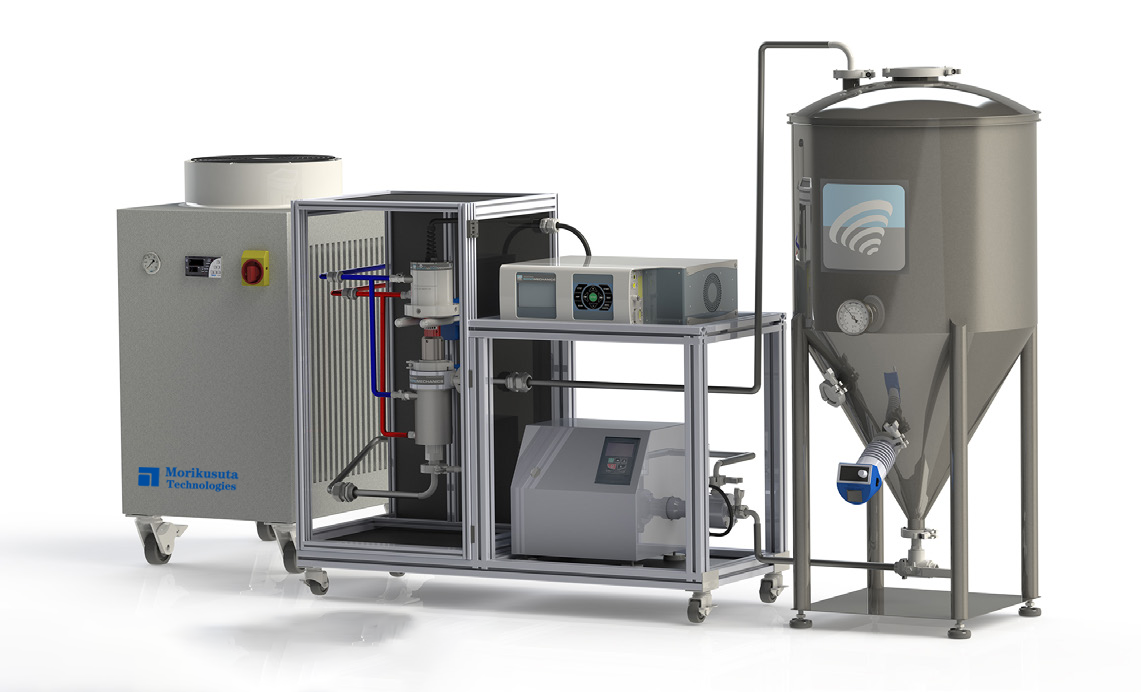
High-amplitude Ultrasonic Processor(Non-thermal)
Beverage Sterilization/Pasteurization/Non-Thermal Sterilization
Morikusuta Technologies offers high-amplitude ultrasonic processors for beverage sterilization and pasteurization. These devices utilize HAUPs ultrasonic technology, which significantly enhances the intensity of ultrasonic liquid processing and ensures reproducible and predictable results at any operational scale.
Background
Currently, thermal treatment is the most commonly used method for microbial inactivation in beverages such as milk and juice. However, this process is known to cause deterioration in flavor and nutritional quality. Thermo-ultrasonic synergistic technology, as a "minimally processed" alternative sterilization/pasteurization solution, has been successfully validated in laboratory-scale applications for various foods, demonstrating efficient microbial inactivation and extended shelf life. Compared to pure thermal treatment, the application of high-amplitude ultrasonic technology significantly reduces processing temperatures while achieving the required level of microbial inactivation and fully preserving the physicochemical properties, freshness, and integrity of bioactive substances in the product. When combined with short-wave ultraviolet radiation (UV-C), the treatment effectiveness can be further enhanced.
For ultrasonic sterilization/pasteurization, extremely high ultrasonic amplitudes (90–120 micrometers) are required. The microbial inactivation promoted by high-intensity ultrasound can be attributed to intense ultrasonic cavitation, which generates violently collapsing vacuum bubbles and forms microjets, hot spots, and localized pressures, thereby disrupting microbial cell walls.
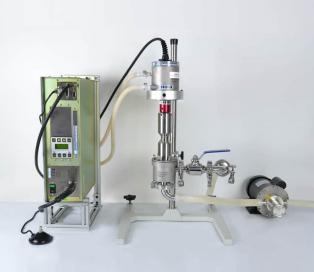
Carrot Juice Sterilization Application Example
The data below were collected through a collaboration between the Washington State University Center for Non-Thermal Food Processing and United Innovative Systems LLC. Washington State University had previously achieved similar results at the laboratory scale (500 ml batches) using conventional high-amplitude ultrasonic processors. HAUPs ultrasonic technology enables process scaling while maintaining ultrasonic amplitude, making commercial applications feasible.
The raw carrot juice used in this experiment was provided by Washington State University and processed using an industrial HAUPs ultrasonic processor. The experimental setup included a combination of an ultrasonic horn (maximum amplitude of 110 micrometers, output end diameter of 45 mm) and a 300 ml reaction chamber (flow cell). This chamber featured a transparent polycarbonate observation section for visual monitoring of the cavitation process. After preheating 5 liters of raw carrot juice to 54°C, Escherichia coli ATCC 11775 was inoculated into the main storage tank. With the ultrasonic function turned off, the juice was circulated through the reaction chamber at a flow rate of 10 liters per minute. Approximately 30 seconds after inoculation, ultrasonic treatment was initiated with the following parameters: ultrasonic amplitude of 110 micrometers, system output power of 2.6 kW, and circulation rate of 10 liters per minute. Samples were taken at 30 seconds, 1 minute, 2 minutes, and subsequently at 2-minute intervals until the 12-minute mark. The samples were tested for mesophilic bacteria, Enterobacteriaceae, E. coli, and yeast/mold. The results are shown below. Since no significant changes were observed after 2 minutes of treatment, overtime sampling data are not displayed.
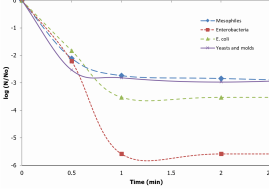
The left graph shows the inactivation of mesophilic bacteria, Enterobacteriaceae, E. coli, and yeast/mold in carrot juice treated with the HAUPs ultrasonic processor (initial colony counts: mesophilic bacteria - 10⁵ CFU/ml, Enterobacteriaceae - 10⁵ CFU/ml, E. coli - 10⁴ CFU/ml, yeast/mold - 10⁵ CFU/ml). After 1 minute of treatment, significant sterilization effects were achieved for all microorganisms, corresponding to a processing rate of 5 liters per minute. Combining high-amplitude ultrasound with short-wave ultraviolet radiation can further enhance treatment depth and rate.
Why Choose HAUPs Ultrasonic Technology?
Prior to the advent of HAUPs ultrasonic technology, existing industrial-grade ultrasonic processors were unable to generate the high amplitudes required for effective sterilization/pasteurization. The benchtop and industrial-grade ultrasonic equipment developed based on HAUPs technology can operate stably at extremely high amplitudes, enabling direct translation of laboratory results to production environments and ensuring reproducible and predictable outcomes. Our devices also offer the advantages of compact structure, low cost, minimal technical support requirements, and very few contact parts.
Conclusion
High-intensity ultrasound combined with mild heating is a simple and efficient technology for beverage sterilization/pasteurization, completely avoiding the side effects associated with traditional thermal treatment methods. With the adoption of HAUPs ultrasonic technology, this process is directly scalable and can be implemented in industrial production environments using HAUPs ultrasonic processors.

Morikusuta Technologies Inc.
| 
|
 ADD:6547 N Academy Blvd #2266 Colorado Springs Co 80918 USA
  TEL:909-990-7728